


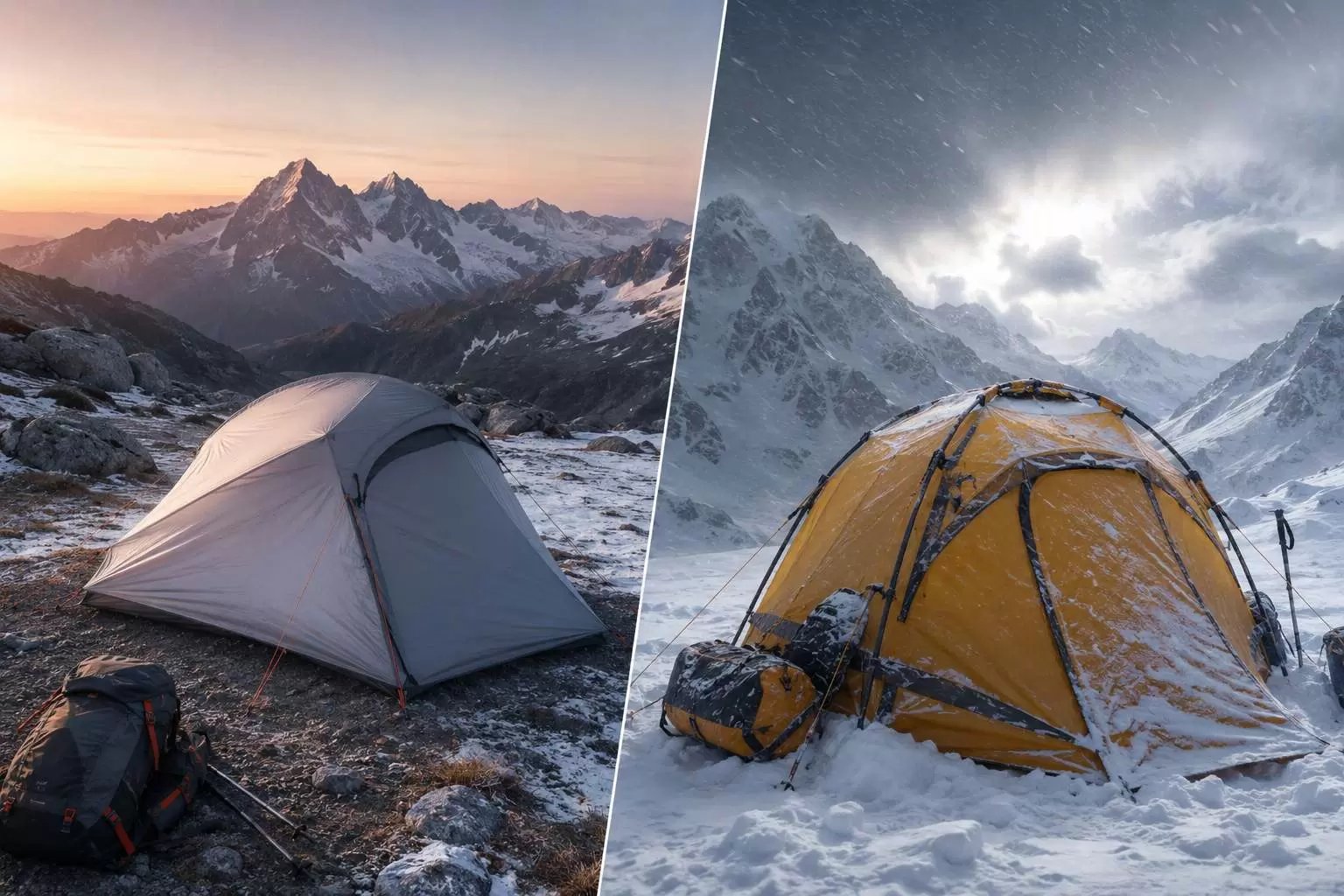
Choosing between a lightweight and a heavy-duty four-season camping tent is one of the most important decisions for winter campers, alpine hikers, and serious outdoor adventurers. While both are designed to handle harsh environments such as snow, strong winds, and freezing temperatures, they serve very different purposes.
The wrong choice can lead to unnecessary weight on the trail—or worse, insufficient protection in extreme conditions. The right choice depends on how you balance weight, durability, weather resistance, comfort, and intended use.
This guide breaks down everything you need to know so you can confidently decide which type of four-season tent fits your adventure style.
Understanding Four-Season Camping Tents First
Before comparing lightweight and heavy-duty options, it’s important to understand what makes a tent “four-season.”
Unlike standard three-season models designed for spring to fall use, four-season tents are built for winter storms, heavy snow loads, and high winds. They typically feature:
Stronger pole systems (often aluminum or reinforced alloys)
Thicker, more durable fabrics
Less mesh for heat retention
Reinforced seams and guy-out points
More aerodynamic, low-profile designs
These features prioritize stability and survival in extreme weather, not comfort or airflow.
In fact, many experts point out that four-season tents are not primarily about warmth—they are about resisting collapse under snow and wind pressure. Your sleeping bag and insulation system provide most of the warmth, not the tent itself.
What Are Lightweight Four-Season Camping Tents?
Lightweight four-season tents are designed for backpackers and fast-moving winter adventurers who still need strong weather protection without carrying excessive weight.
Key Characteristics
Typically under 2–3 kg (varies by model and capacity)
Advanced lightweight materials like high-tenacity nylon or Dyneema blends
Minimal pole structure, often simplified geodesic or single-hoop systems
Compact packed size for backpacking
Balanced ventilation for mixed conditions
Advantages of Lightweight Four-Season Tents
The biggest advantage is obvious: reduced pack weight.
For long-distance hikers or ski tourers, every kilogram matters. A lighter tent:
Reduces fatigue on long ascents
Makes multi-day expeditions more manageable
Packs easily into a backpack
Supports fast setup in cold, harsh conditions
Modern material innovation has made it possible to build lighter tents that still handle winter conditions reasonably well, especially in moderate alpine environments rather than extreme base camps.
Limitations of Lightweight Models
However, weight reduction always comes with trade-offs:
Less resistance to extreme snow accumulation
Smaller interior space
More vulnerability in prolonged storms
Often higher cost due to advanced materials
Requires more careful pitching technique
Lightweight tents are excellent—but they are not designed for long-term exposure to severe winter storms or heavy basecamp use.
What Are Heavy-Duty Four-Season Camping Tents?
Heavy-duty four-season tents are built for maximum durability and survival-level protection. These are the tents used in mountaineering expeditions, polar conditions, and high-altitude base camps.
Key Characteristics
Heavier weight (often 4–10+ kg depending on size)
Strong geodesic or dome-shaped frames with multiple poles
Thick denier fabrics with reinforced stress points
Minimal mesh and strong storm flaps
Multiple guy lines for anchoring in high winds
Advantages of Heavy-Duty Four-Season Tents
The main advantage is extreme weather performance.
Heavy-duty tents are engineered to:
Withstand heavy snow loading without collapsing
Resist high winds above treeline or on exposed terrain
Maintain structural integrity during multi-day storms
Offer more interior stability and durability for long stays
They are especially suitable for:
Base camps in mountainous regions
Arctic or subarctic expeditions
Snow-heavy environments
Static winter camping where weight is less important
Many professional-grade tents in this category prioritize stability so much that they can remain standing in conditions where lighter tents would fail.
Limitations of Heavy-Duty Models
Despite their strength, heavy-duty tents come with significant drawbacks:
Heavy and bulky to carry
Slower to transport and set up
Less breathable in mild weather
Can feel excessive for casual winter camping
Higher physical effort required during travel
Because of this, they are rarely used for fast-and-light backpacking.
Key Differences: Lightweight vs Heavy-Duty Four-Season Tents
To understand the trade-offs clearly, here is a direct comparison of their core characteristics:
Weight and Portability
Lightweight tents prioritize mobility, often saving several kilograms compared to heavy-duty models. Heavy-duty tents, however, sacrifice portability for strength and stability.
Weather Resistance
Heavy-duty tents outperform lightweight ones in snow load capacity and wind resistance, especially in prolonged storms or exposed alpine zones.
Durability
Heavy-duty tents typically last longer under extreme use, while lightweight tents require more careful handling and may wear faster if abused.
Comfort and Space
Heavy-duty tents often provide slightly more interior stability and livable space. Lightweight tents focus on compact efficiency rather than spaciousness.
Setup Speed
Lightweight tents are generally faster to pitch, which is valuable in freezing conditions where exposure matters. Heavy-duty tents may require more time due to additional poles and anchoring systems.
Which One Should You Choose?
The decision ultimately depends on your camping style and environment.
Choose a Lightweight Four-Season Tent If You:
Do winter backpacking or ski touring
Need to minimize pack weight
Move camp frequently
Camp in moderately harsh winter conditions
Value speed and efficiency over maximum durability
In short, lightweight tents are ideal for mobile winter adventures.
Choose a Heavy-Duty Four-Season Tent If You:
Camp in extreme alpine or polar environments
Expect heavy snow or high winds
Stay in one basecamp for multiple days or weeks
Prioritize safety and durability over weight
Use sleds, vehicles, or basecamp transport systems
Heavy-duty tents are designed for survival-level reliability in extreme conditions.
A Common Misunderstanding: “Warmer” vs “Stronger”
One of the biggest misconceptions is that heavy-duty tents are significantly warmer. In reality:
A tent does not generate heat
Insulation mainly comes from sleeping gear
Four-season tents mainly block wind and snow, not cold itself
Both lightweight and heavy-duty tents can feel cold in winter. The difference is that heavy-duty models are better at preventing structural failure and blocking wind exposure, not providing insulation.
Hybrid and Modern Trends
Recent tent innovations have blurred the line between lightweight and heavy-duty designs. Many modern four-season tents aim to:
Reduce weight without sacrificing core strength
Improve ventilation to reduce condensation
Use stronger yet lighter pole materials
Offer modular designs for different conditions
This has created a growing category of “all-season capable” tents that sit between the two extremes.
However, even these hybrid designs still require you to prioritize either mobility or maximum durability.
Final Thoughts
Choosing between lightweight and heavy-duty four-season camping tents is not about finding the “best” tent overall—it’s about choosing the right tool for your environment.
If you need agility, efficiency, and reduced pack weight, a lightweight model is your best companion. If your priority is surviving harsh weather in remote, exposed environments, a heavy-duty tent is the safer investment.
In the end, the best tent is the one that matches your terrain, duration, and risk level, not just your budget or preference for comfort.







 SIGN UP FOR NEWSLETTER
 Room 2015, Building 1, No. 114, Pudong, Xiaojiang Village, Shuangpu Town, Xihu District, Hangzhou City, Zhejiang Province
